Strategy

Strategy for UPSC:

The UPSC Civil Services Exam has three stages:

  • Prelims (screening, objective)
  • Mains (descriptive, main scoring)
  • Interview (personality test).

Total marks:

  • Prelims (qualifying)
  • Mains (1750)
  • Interview (275).

Aim for integrated preparation since Prelims and Mains overlap significantly (no separate strategies—build depth for Mains while practicing MCQs for Prelims).

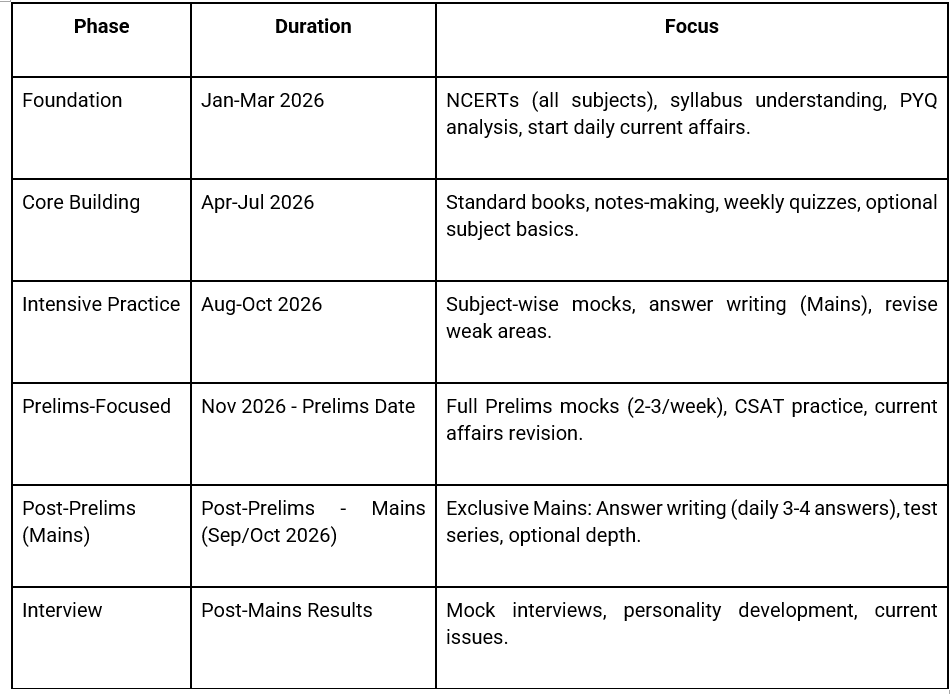
Start at least 12 months before Prelims (target UPSC 2027: Prelims in May/June 2027).
Prelims Strategy

  • Prelims consists of GS Paper 1 (200 marks, qualifying for Mains) and CSAT Paper 2 (qualifying, 33% cutoff).
  • Textbooks (build knowledge), Test Series (practice), Techniques (smart strategies like PYQ analysis).
  • Analyze 10+ years’ PYQs to spot patterns.

Focus:

  • 70% on static syllabus coverage via NCERTs (Class 6-12)
  • 20% on current affairs (1 year back)
  • 10% on mocks for accuracy above 110+ in GS Paper 1.​
  • Current Affairs: The Hindu/Indian Express + Mentora IAS compilations; link to syllabus themes.
  • Mocks: 30-40 full tests; analyze errors for elimination techniques.

General Studies Paper-II (CSAT):

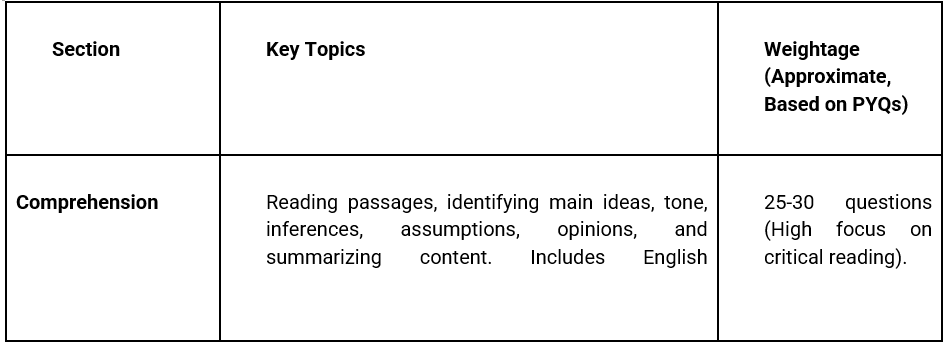
  • The Civil Services Aptitude Test (CSAT), also known as General Studies Paper-II, is a qualifying paper in the UPSC Civil Services Preliminary Examination.
  • It carries 200 marks with 80 multiple-choice questions, each worth 2.5 marks, and has a duration of 2 hours. There’s a negative marking of 0.83 marks (1/3rd) for each wrong answer.
  • To qualify, you need at least 33% (66.67 marks), regardless of your performance in GS Paper-I.
  • Failing CSAT disqualifies you from advancing to the Mains, even if you ace the first paper.
  • The paper tests skills at a Class X level, focusing on aptitude, reasoning, and basic numeracy, but recent trends show increasing difficulty, especially in comprehension and quantitative sections. Focus:
    • Accuracy (2/3rd cut-off ~90-100/200)
    • Avoid negatives (1/3rd penalty).
  • Solve 50-100 MCQs/day.
  • Thorough analysis of Previous Year Questions.
  • Join test series for 20-30 full mocks.

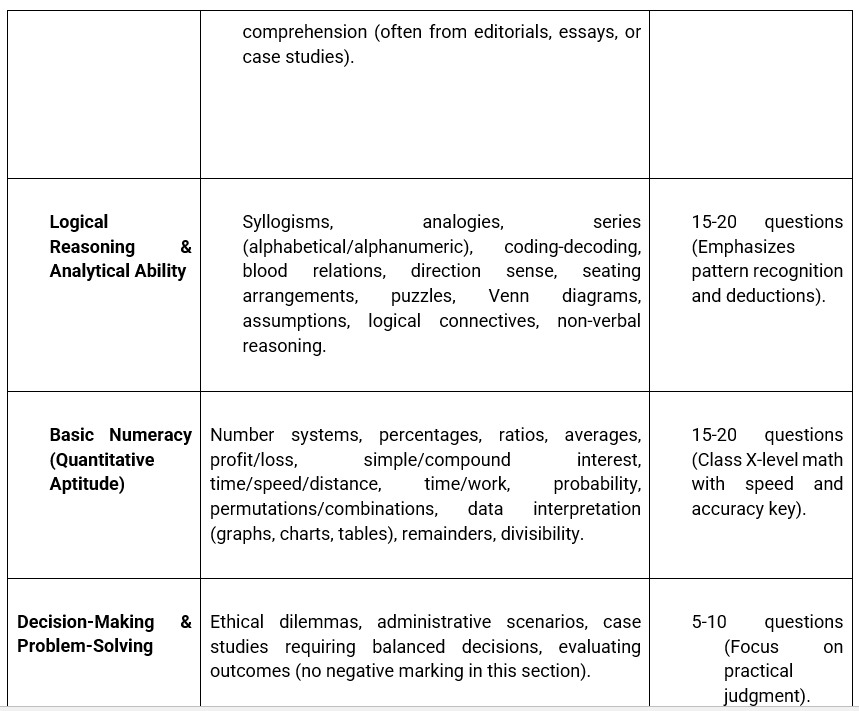
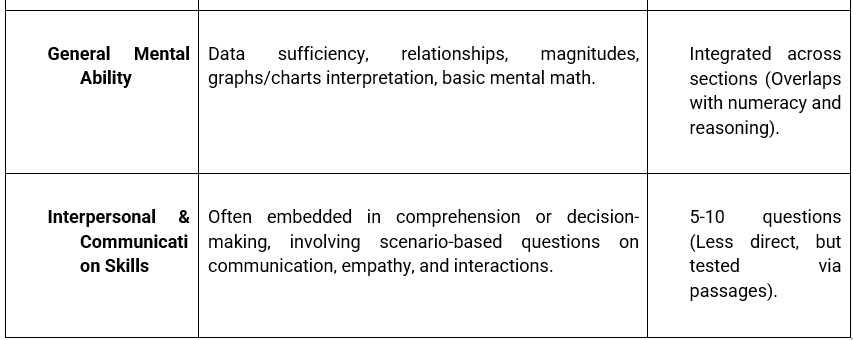
CSAT Syllabus Breakdown

Overall Preparation Strategy

  • CSAT preparation requires a balanced, strategic approach rather than exhaustive study—aim for efficiency since it’s qualifying.
  • Start by assessing your baseline: Solve 5-10 PYQs from the last decade (e.g., 2015-2024) without time limits to identify strengths and weaknesses.
  • If you score above 100 consistently, you may need minimal prep (1-2 months); if below 80, dedicate 3-4 months with focused effort.

Key principles:

  • Consistency Over Intensity: Dedicate 1-2 hours daily rather than cramming. Build habits like daily reading and puzzle-solving.
  • Focus on High-Yield Topics: Prioritize PYQ-repeated areas like comprehension (editorials), basic arithmetic (percentages, ratios), and reasoning (syllogisms, puzzles). Avoid overstudying low-frequency topics.
  • Time Management: In the exam, aim for 75-80% accuracy in your strong sections first. Skip or guess minimally to avoid negative marking—target 35-40 correct answers (out of 80) to safely qualify.
  • Balanced Prep: If from a non-math background, spend more on numeracy; if weak in English, focus on reading. Use shortcuts and tricks (e.g., elimination method for MCQs).
  • Revision and Analysis: Revise formulas, tricks, and weak areas weekly. After every practice session, analyze errors—why you got it wrong and how to fix it.
  • Avoid Common Mistakes: Don’t ignore mocks, over-rely on guesswork, or neglect weak areas. Stay calm; panic leads to poor decisions.

Official and Government Websites (Essential for Authentic Data and Syllabus, works well for Mains as well):

  • gov.in: The official UPSC site for notifications, syllabus, previous year papers (PYQs), and exam updates.
  • gov.in: Press Information Bureau for government press releases, schemes, and current affairs.
  • nic.in: Download free NCERT textbooks (Class 6-12), foundational for all subjects.
  • ac.in: National Institute of Open Schooling for supplementary study materials.
  • ac.in: IGNOU’s repository for e-books and notes on various subjects.
  • gov.in: National portal for policies, schemes, and reports.
  • gov.in and kurukshetra.gov.in: Monthly magazines on development issues, economy, and rural India—key for Mains GS papers.
  • gov.in: Ministry of External Affairs for international relations and foreign policy updates.

Paper-wise detailed strategy (Mains):

General Studies-I:

  • UPSC Mains General Studies Paper I covers Indian heritage, history, geography, and society, requiring analytical answers blending static knowledge with current affairs.

Syllabus Breakdown:

  • GS Paper I spans five key areas:
    • Indian Heritage and Culture (art forms, literature, architecture);
    • History (modern Indian, world history like revolutions and wars);
    • Geography (physical, human, world resources, disasters); and
    • Society (globalization effects, urbanization, women empowerment, poverty).
    • Questions total 20 (10 at 10 marks/150 words, 10 at 15 marks/250 words) for 250 marks in 3 hours.​

Foundational Sources:

  • Build basics with NCERTs (Class 6-12) for history; R.S. Sharma (Ancient India); Satish Chandra (Medieval India); Bipan Chandra (Modern India).
  • Geography (NCERT, GC Leong, Majid Husain)
  • Culture (Nitin Singhania).
  • Supplement with Yojana/Kurukshetra for society. ​

Preparation Timeline

  • Months 1-3: Cover static syllabus via NCERTs and one standard book per section; make concise notes (1-2 pages/topic) with timelines, maps.
  • Months 4-6: Integrate current affairs (The Hindu, RSTV); analyze 10-year PYQs to identify patterns like geography’s rise.
  • Final Month: Daily answer writing (7-5-3 rule: 7 mins/10 marks, 5 points, intro-body-conclusion); 2 full mocks weekly. Revise notes thrice, focusing on weak areas like world history.​

Answer Writing Tips

  • Use multi-dimensional structure: define issue, causes/examples, solutions/policies, conclusion with way forward.
  • Incorporate visuals (maps for geography, flowcharts for society trends) and data (e.g., census stats, schemes like PMAY).
  • Practice toppers’ techniques: link history to present (e.g., Phule’s reforms to women’s schemes), aim for balanced views on society topics. Get feedback to refine clarity and word limit adherence.​


General Studies-II:

  • It focuses on Governance, Constitution, Polity, Social Justice, and International Relations, emphasizing analytical depth, integration of static knowledge with current affairs, and application to real-world scenarios.
  • The paper tests your ability to think like a policymaker, linking theory to practice, and often requires balanced, solution-oriented responses.
  • Questions are interdisciplinary, with overlaps (e.g., governance with ethics or polity with social justice), and heavily inclined toward current affairs—around 50-60% of questions draw from recent events.
  • Difficulty is moderate to high, with trends showing increased focus on judicial reforms, neighborhood diplomacy, and welfare scheme evaluations.

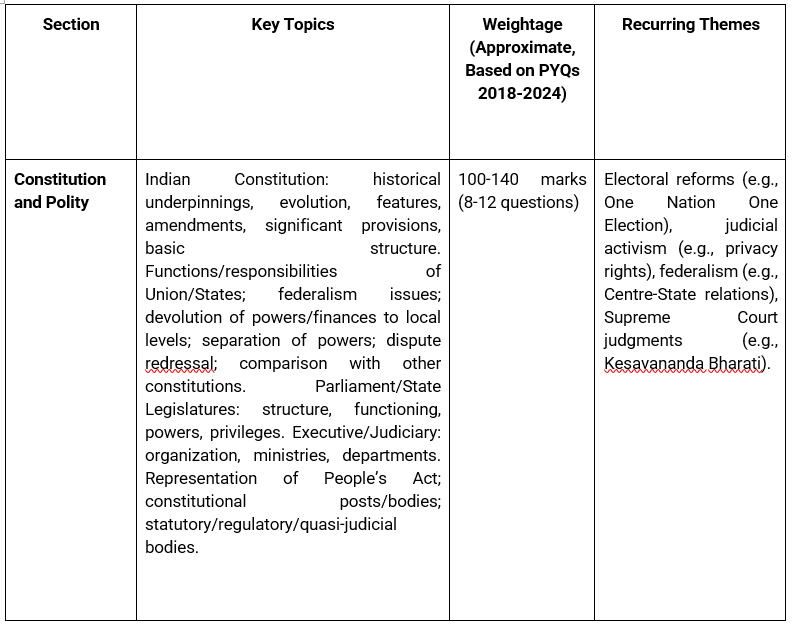
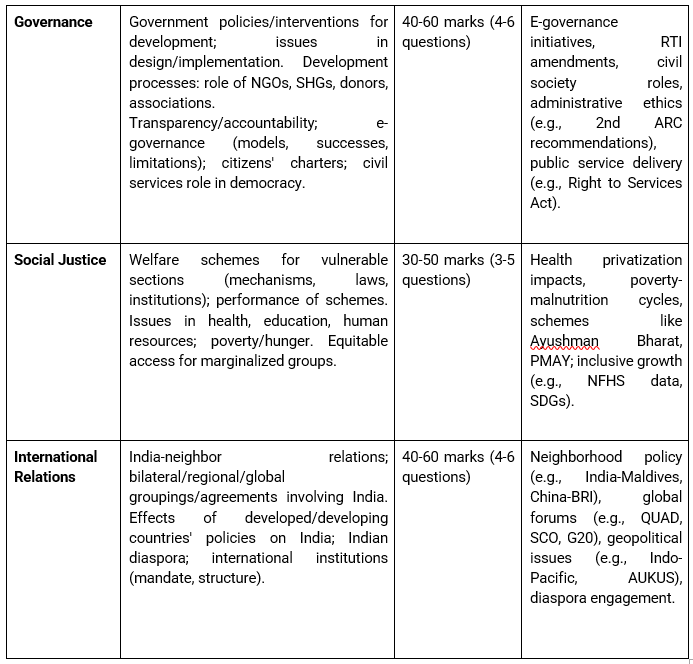
GS Paper II Syllabus Breakdown:

Overall Preparation Strategy

  • GS-II demands an integrated approach: 40% static knowledge, 40% current affairs, and 20% answer writing practice.
  • Start by assessing your baseline—solve PYQs from the last 5-7 years (2018-2024) to identify gaps.
  • If strong in polity (e.g., from Prelims prep), focus more on IR and governance; if weak in current affairs, prioritize daily reading.
  • Aim for 4-6 months of dedicated prep post-Prelims (e.g., starting June 2026 for September Mains), with 2-3 hours daily.

Key principles:

  • Integrated Study: Link static topics to dynamics (e.g., federalism with recent Centre-State disputes). Use PYQs to map recurring themes.
  • Current Affairs Focus: Dedicate 50% time to newspapers/magazines; note examples, data, and perspectives.
  • Analytical Mindset: Shift from descriptive to analytical—evaluate pros/cons, suggest reforms.
  • Practice-Oriented: Write 2-3 answers daily after Month 2; join a test series for feedback.
  • Revision Cycles: Weekly revise notes; monthly full-paper mocks. Target 120+ in mocks.
  • Avoid Pitfalls: Don’t ignore IR (low static, high dynamic); balance opinions; use data/judgments sparingly but effectively.
  • For Beginners: Build basics first; for repeaters, refine answer structure.

Section-Wise Preparation Tips

Constitution and Polity

  • Master core concepts: Read Laxmikanth multiple times; focus on amendments, articles (e.g., Art. 368 for amendments), and comparisons (e.g., India vs. USA federalism).
  • Techniques: Quote SC judgments (e.g., SR Bommai for federalism); analyze PYQs for patterns like electoral reforms. Integrate current events (e.g., One Nation One Election report).
  • Daily Practice: 1 hour reading + note-making on debates (e.g., judicial overreach).

Governance

  • Focus on application: Study 2nd ARC reports (e.g., ethics, local governance); understand e-governance models and limitations.
  • Techniques: Use case studies (e.g., Aadhaar for transparency); evaluate policies with pros/cons. Link to ethics (e.g., civil services reforms).
  • Daily Practice: Analyze PRS bills; note examples from PIB.

Social Justice

  • Emphasize schemes and issues: Cover Ayushman Bharat, PMJDY; analyze data (e.g., Global Hunger Index, NFHS).
  • Techniques: Use flowcharts for cycles (e.g., poverty-hunger); suggest reforms based on SDGs or committees.
  • Daily Practice: Read Yojana for grassroots examples; focus on vulnerable sections.

International Relations

  • Build historical context: Map bilateral ties (e.g., India-China border disputes); track groupings (e.g., QUAD’s role in Indo-Pacific).
  • Techniques: Multidimensional analysis (e.g., trade, defense, culture in India-US relations); use maps for visualization. Stay neutral on geopolitics.
  • Daily Practice: Read MEA briefs; editorials on events (e.g., BRI impacts).

Recommended Resources and Books

  • Core Books:
    • Indian Polity by M. Laxmikanth (must-read 3-4 times).
    • Introduction to the Constitution of India by D.D. Basu (for depth).
    • Governance in India by M. Laxmikanth.
    • Contemporary World Politics (12th Class NCERT)
    • Oxford Handbook of Indian Foreign Policy.
    • 2nd ARC Reports (selective: Ethics, RTI, Local Governance).
  • Current Affairs: The Hindu/Indian Express (editorials); Yojana/Kurukshetra; PIB; PRS India; for IR: Bilateral Briefs of Ministry of External Affairs, Council for Foreign Relations (CFR).

Study Plan

  • Month 1: Foundations: Read Laxmikanth (Polity); NCERTs for basics. Analyze PYQs; make topic-wise notes.
  • Month 2: Governance & Social Justice: Cover 2nd ARC, schemes; daily current affairs (1 hour). Write 1 answer/day.
  • Month 3: International Relations : Study bilateral ties, groupings; integrate editorials. Weekly revision.
  • Month 4: Integration & Practice: Link sections; full mocks (1/week). Focus on weak areas.
  • Month 5: Intensive Writing: Daily answers (2-3); test series (10-15 papers). Revise notes/data.

Month 6: Final Polish: 2 full mocks/week; quick revisions. Focus on judgments, stats, examples

Answer Writing Strategy

Answers must be structured, balanced, and within word limits (150 for 10-markers, 250 for 15-markers).

  • Introduction: Define key terms; set context with articles/judgments (e.g., start with Art. 21 for privacy).
  • Body: 3-5 subheadings; pros/cons; substantiate with examples (e.g., SC cases, data, reports). Use diagrams/maps/flowcharts sparingly.
  • Conclusion: Solution-oriented; link to Preamble/SDGs/reforms. Tips: Analytical over descriptive; quote judiciously (e.g., Justice Malhotra on gender diversity); practice for clarity and flow. Get feedback to avoid bias.

Exam Day Tips

  • Time Management: 9 minutes per 10-marker, 14 for 15-marker. Attempt all—start with strengths.
  • Prioritize: Polity questions first if comfortable; ensure balance in views.
  • Presentation: Neat handwriting, underlining key points; avoid overwriting.
  • Stay Calm: Focus on analysis; use examples from prep to enrich.

General Studies III:

  • General Studies Paper III (GS III) is often considered the most dynamic and “rank-defining” paper in the UPSC Mains.
  • It covers Technology, Economic Development, Biodiversity, Environment, Security, and Disaster Management.
  • The key to mastering GS III is moving beyond basic theory to policy-based analysis and data-driven arguments.

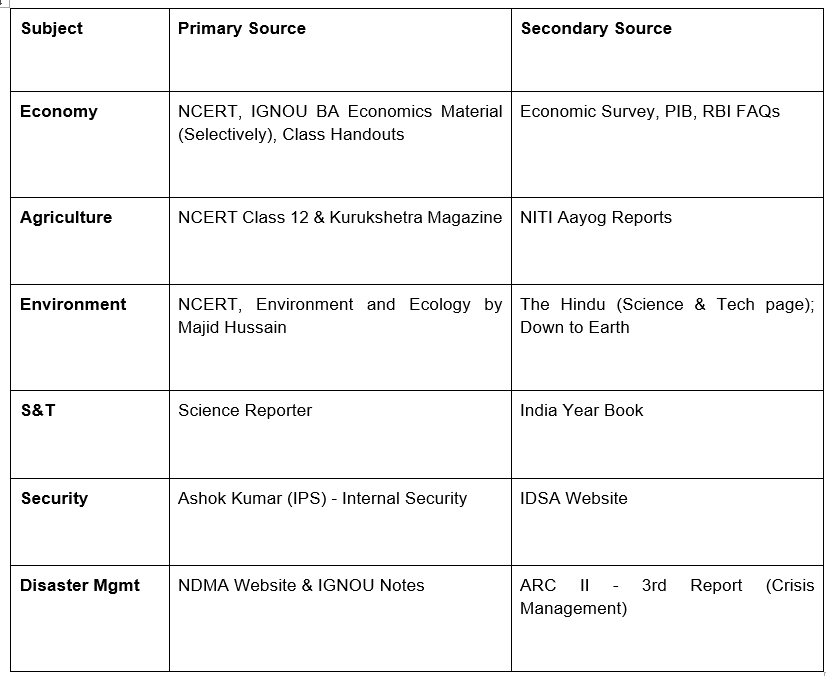
1. Subject-Wise Micro-Strategy

A. Indian Economy & Agriculture (50% of the Paper)

This section is the backbone of GS III. You must link economic concepts to social outcomes.

  • The Big Three: Thoroughly analyze the Economic Survey, Union Budget, and NITI Aayog’s 3-year Action Agenda.
  • Agriculture Focus: Prepare 1-page notes on MSP (Minimum Support Price), PDS reforms, Food Processing, and Irrigation.
  • Keywords: Use terms like Inclusive Growth, Investment Models (PPP), and Supply Chain Management.
  • Data Points: Memorize 5-10 key statistics (e.g., Agriculture’s % share of GDP, current fiscal deficit, unemployment rates).

B. Science & Technology

UPSC rarely asks purely theoretical science questions; they focus on applications and everyday life.

  • Frontier Tech: Focus on AI, Blockchain, Quantum Computing, Nanotechnology, and Biotechnology (specifically CRISPR-CAS9 and GM Crops).
  • Space & Defence: Track ISRO’s latest missions (e.g., Gaganyaan, SPADEX) and indigenization of defense (DRDO).
  • Strategy: For every new technology, prepare a “Benefit-Challenge-Regulation” framework.

C. Environment & Biodiversity

  • Climate Change: Be thorough with COP Summits (like COP28/29), the Paris Agreement, and India’s “Panchamrit” targets.
  • Pollution: Focus on Urban Air Quality, Plastic Waste Management, and Circular Economy.
  • Reports: Quote the IPCC Reports, India State of Forest Report (ISFR), and the Living Planet Report.

D. Internal Security & Disaster Management

  • Security: Understand the “Development-Extremism Nexus.” Prepare themes like Cyber Security, Money Laundering, and Border Management.
  • Disaster Management: The NDMA Guidelines for specific disasters (Floods, Cyclones, Earthquakes) are your primary source. Mention the Sendai Framework for Disaster Risk Reduction.
  • Mapping: For questions on North-East insurgency or Border Security, always draw a rough map of India to show affected areas.

2. The "GS III Answer Writing" Formula

To score 100+ marks, your answers must look “official” and well-researched:
  1. Introduction: Start with a recent fact, a definition, or a statistic (e.g., “India is the 5th largest economy…”).
  2. Body: Use sub-headings exactly as they appear in the syllabus. Use flowcharts for processes (e.g., the flow of the PDS system).
  3. Case Studies: Mention successful examples like the Sikkim Organic Farming Model or the Odisha Disaster Management Success during cyclones.
  4. Conclusion: Always end with a Way Forward that includes a committee recommendation (e.g., Ashok Dalwai Committee for Agriculture or Bibek Debroy Committee for Railways).

3. Recommended Resource List

GS Paper IV

  • General Studies Paper IV (GS-IV), known as Ethics, Integrity, and Aptitude.
  • Unlike other GS papers, it emphasizes subjective interpretation, introspection, and practical wisdom over factual recall, with no single “correct” answer—multiple balanced approaches can score well.
  • Questions often link to current affairs, governance dilemmas, and civil service values, testing integrity, empathy, and accountability.
  • Recent trends (2023-2025) show increasing complexity in case studies (longer, multi-stakeholder dilemmas), focus on contemporary issues like AI ethics, environmental justice, and public trust in institutions, and a shift toward analytical depth rather than rote quotes.

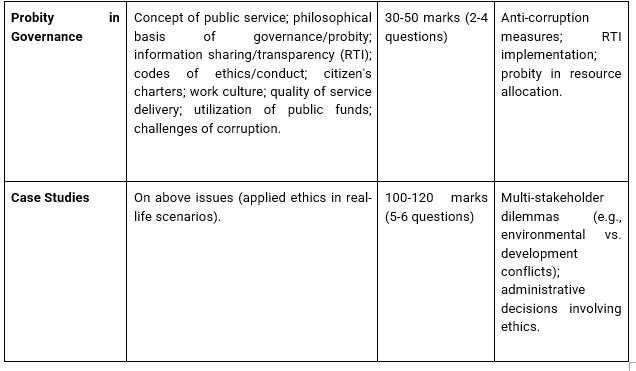
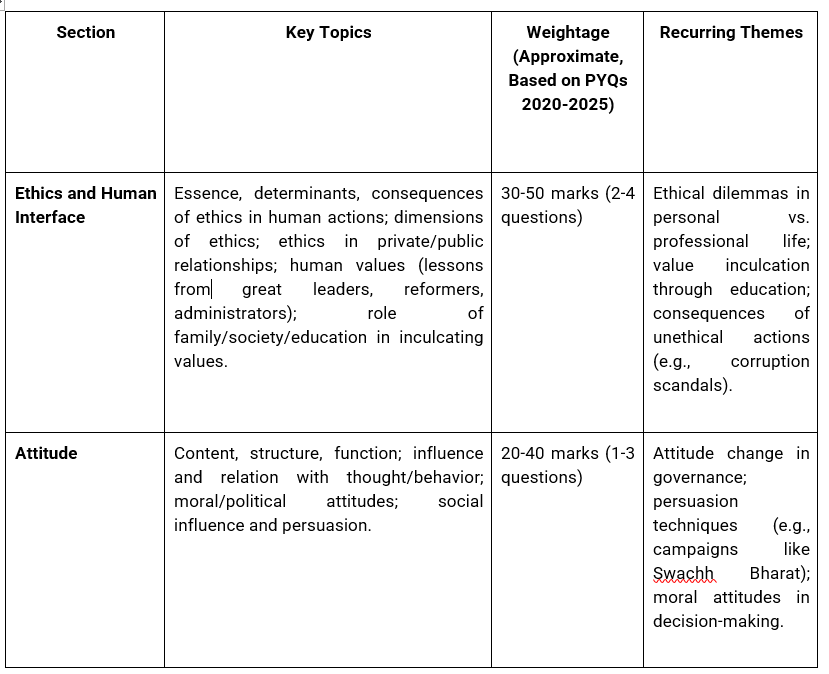
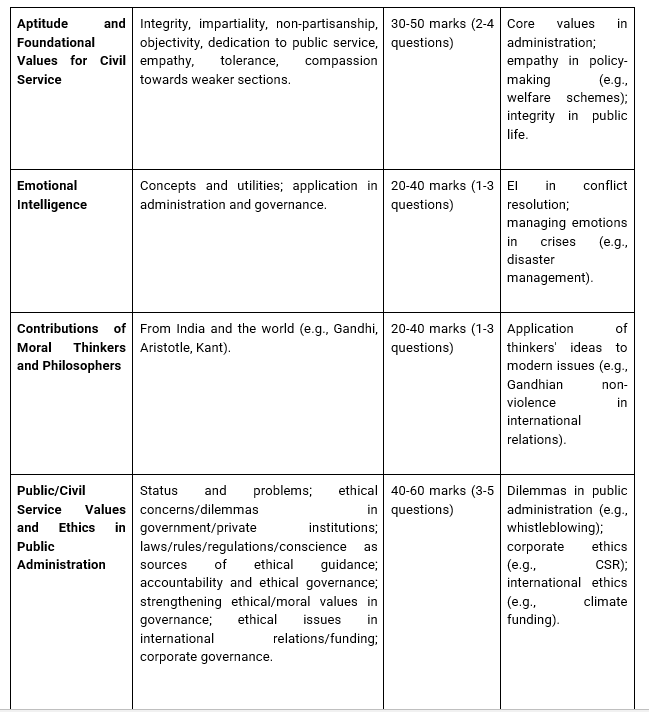
GS Paper IV Syllabus Breakdown

The syllabus is conceptual and application-oriented, divided into theory (Section A) and case studies (Section B).
Overall Preparation Strategy

  • GS-IV demands a blend of conceptual clarity (40%), real-life application (40%), and introspective practice (20%).
  • It’s not about mugging but developing an ethical mindset—focus on originality, logic, and personal reflection rather than faking morality.
  • Start with a baseline: Analyze PYQs from 2018-2025 to identify patterns (e.g., recurring dilemmas).
  • Dedicate 2-4 months post-Prelims (e.g., June-September 2026), with 1-2 hours daily.

Key principles:

  • Introspection and Authenticity: Reflect on personal experiences; avoid forced quotes—use sparingly for relevance.
  • Current Affairs Linkage: Integrate news (e.g., ethical lapses in elections) for examples; track 1 year of developments.
  • Balanced Views: Present pros/cons; prioritize practical, implementable solutions over idealistic ones.
  • Practice-Oriented: 50% time on case studies; use mocks to simulate pressure.
  • Revision: Weekly revisit notes/examples; monthly full-paper practice. Target 120+ in mocks.
  • Avoid Pitfalls: Don’t overload resources; ignore jargon; focus on rationality over philosophy.
  • For Repeaters: Emphasize nuanced analysis from 2025 trends (e.g., tech-governance intersections).

Section-Wise Preparation Tips

Ethics and Human Interface

  • Focus on dimensions: Private vs. public ethics; use examples from leaders (e.g., Ambedkar on social justice).
  • Techniques: Explain determinants/consequences with diagrams (e.g., value inculcation cycle).

Attitude and Aptitude/Foundational Values

  • Study structure/functions; link to behavior change (e.g., persuasion in policy).
  • Techniques: Map values to personalities (e.g., Gandhi for integrity); practice application in dilemmas.

Emotional Intelligence

  • Cover concepts/utilities; apply to governance (e.g., EI in team management).
  • Techniques: Use flowcharts for EI components; solve end-of-chapter questions.

Contributions of Moral Thinkers

  • Focus on relevance: Understand context/significance (e.g., Kant’s deontology in duty-bound decisions).
  • Techniques: Note 10-15 key thinkers; apply to current issues sparingly.

Public/Civil Service Values and Probity in Governance

  • Emphasize dilemmas: Sources of guidance (e.g., conscience vs. law); anti-corruption tools (e.g., RTI).
  • Techniques: Analyze ARC reports; link to international/corporate ethics.

Case Studies

  • Master framework: Summarize case; list stakeholders/dilemmas; evaluate options (3-4 with pros/cons); choose balanced action with steps.
  • Techniques: Prioritize empathy/accountability; use first-person (“I would…”); end with quote if fitting. Practice timed (15 min/case).

Recommended Resources and Books

  • Core Books:
    • Ethics, Integrity and Aptitude by G. Subba Rao & P.N. Roy Chowdhury (selective chapters).
    • Lexicon for Ethics, Integrity & Aptitude by Chronicle.
    • Justice: What’s the Right Thing to Do? by Michael Sandel (or Harvard videos).
    • 2nd ARC Reports (Ethics in Governance, Code of Conduct).
    • IGNOU Materials (Ethics basics, Ethical Concerns in Public Administration).
    • NCERT Psychology (Class 12, Ch. 6-7 for Attitude).
  • Current Affairs: The Hindu/Indian Express editorials; Yojana; PIB for ethical issues.

Study Plan

  • Month 1: Foundations: Scan syllabus/PYQs; read Subba Rao/Lexicon for basics; watch Harvard videos; make notes on definitions/thinkers.
  • Month 2: Theory Deep Dive: Cover attitude/EI/values; build examples database; daily 1-2 theory questions.
  • Month 3: Applied Ethics: Focus on governance/probity; analyze current affairs; practice 2-3 case studies daily.
  • Month 4: Practice and Revision: Full mocks (1/week); revise notes/examples; get feedback on answers.

Answer Writing Strategy

Answers should be structured, concise (150-250 words), and reflective.

  • Theory: Intro (definition/quote); Body (significance, examples, analysis); Conclusion (application to governance).
  • Case Studies: Framework: Facts summary; Stakeholders/dilemmas; Options evaluation; Chosen action (steps, justification); End with ethical principle. Tips: Use diagrams/flowcharts; balance views; draw from personal/current examples; practice for clarity/formal tone. Feedback essential.

Exam Day Tips

  • Time: 90 min for Section A, 90 for B; start with strengths.
  • Attempt All: Prioritize structure over length; use bullets for clarity.
  • Presentation: Neat, underlined keywords; avoid extremes.
  • Stay Authentic: Focus on logical, empathetic decisions; recall examples calmly.